Sunday, September 25, 2016

Hunger

As a child I can clearly remember experiencing hunger, it was very stressful for me to see my mother going to work to provide for us and still couldn't make ends meet.  I remember coming home from school with no food to eat and my mother being stressed out because she couldn't provide for us.  I was born and raised in Belize City where poverty is big and it is a must to have a good paying job to make a living so hunger was one of our biggest stressor at home.


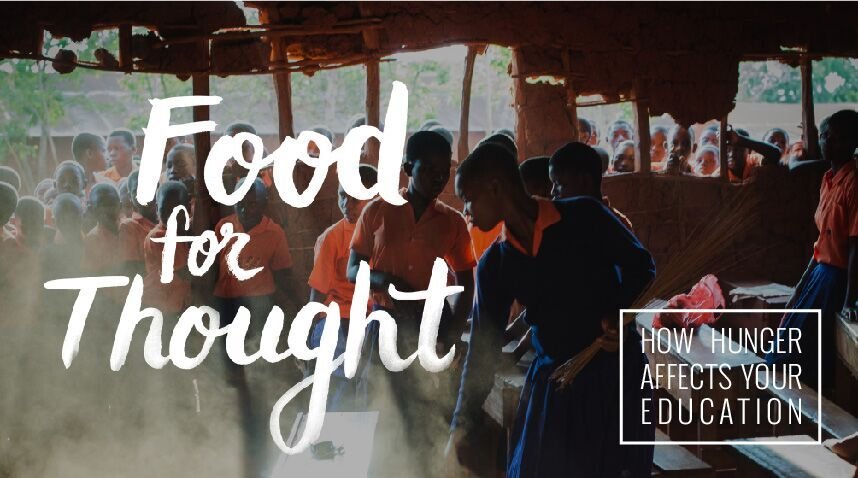
Food for thought: How hunger affects your education

By Callie Stevens|
Brought to you by: World Vision
Photo: Joe Were, Graphic: Alana Espineli
Have you ever sat through a class that’s right before lunch, staring at the second hand on the clock, imagining you're crunching on chips? Watching that clock becomes far more important than French or algebra.
For too many kids in the world, their first meal of the day is dinner. Lunchtime doesn’t mean relief from chronic hunger, and that hunger drastically impacts the way children learn.
It turns out hunger doesn’t just affect how we learn or pay attention in school – it also affects how well our brain works or develops. A healthy brain uses 20% of the body’s energy, and energy comes from food. That means that hunger starves the brain.

This article is interesting because in shows how hunger affected me when I was a child, so I always make sure my students receive a meal when in my care.  This shows how much children are still being affected by hunger in places all over the map.The present study utilised the approach employed by the World Bank, which imputes for non-food elements by taking the average spent by the poorest 40 percent of the population on these items. The sum of the values of the minimum food requirements and the non-food elements constitute the poverty line. The study also relied on expenditure data rather than on income in identifying the level of well-being in a household and among individuals.

The data for the assessment of poverty were derived from a national survey conducted by the Central Statistical Office (CSO) of Belize in mid-1995. The survey design was patterned after the Labour Force Survey that the CSO has been conducting on a biannual basis, since the early 1990s. 

Saturday, September 10, 2016

Immunization

Immunization is important to me because it can save a child's life.  I think it is important for children to be updated with immunization until the immune system is well build up strong.
 According to the Advisory committee of immunization, "In February 2000, a 7-valent pneumococcal polysaccharide-protein conjugate vaccine (Prevnar, marketed by Wyeth Lederle Vaccines) was licensed for use among infants and young children. CDC's Advisory Committee on Immunization Practices (ACIP) recommends that the vaccine be used for all children aged 2-23 months and for children aged 24-59 months who are at increased risk for pneumococcal disease (e.g., children with sickle cell disease, human immunodeficiency virus infection, and other immunocompromising or chronic medical conditions). ACIP also recommends that the vaccine be considered for all other children aged 24-59 months, with priority given to a) children aged 24-35 months, b) children who are of Alaska Native, American Indian, and African-American descent, and c) children who attend group day care centers. This report includes ACIP's recommended vaccination schedule for infants at ages 2, 4, 6, and 12-15 months. This report also includes a pneumococcal vaccination schedule for infants and young children who are beginning their vaccination series at an older age and for those who missed doses. In addition, this report updates earlier recommendations for use of 23-valent pneumococcal polysaccharide vaccine among children aged > or =2 years. Among children aged 24-59 months for whom polysaccharide vaccine is already recommended, ACIP recommends vaccination with the new conjugate vaccine followed, > or =2 months later, by 23-valent polysaccharide vaccine. Conjugate vaccine has not been studied sufficiently among older children or adults to make recommendations for its use among persons aged > or =5 years. Persons aged > or =5 years who are at increased risk for serious pneumococcal disease should continue to receive 23-valent polysaccharide vaccine in accordance with previous ACIP recommendations".

Friday, September 2, 2016

ChildBirth Experiences

Birth in Belize [April 2008]

I’ve lived in Belize for over a year, however, I don’t like what I see. I have delivered four babies here in Belize. Since I am retired (sort of) all these couples have found me. Each of them wanted a natural birth.
From talking with other women here, I have learned that the c-section rate is rising, and for silly reasons. Like being overdue—when she was only 39 weeks by LMP and conception; and weak—she was told that because she was a vegetarian she could not handle the stress of labor.
Another did not want to be slapped in labor (they are supposed to be quiet) and also did not want an episiotomy. All first-time moms in Belize hospitals get an episiotomy, are required to use stirrups and no family members are allowed at hospital births. Also c-sections are given for progress that is too slow.
Women receive no childbirth education or dietary advice. Breastfeeding is supposed to be encouraged, but women are told routinely reasons they cannot: baby too small, baby needs food for the first few days because you have no milk, your nipples are too big. These are just things that I have been told personally.
Hospital staff are not motivated to change their behavior, as all are on salary and they get the same poor pay whether they are nice or not or whether anyone turns up to have the baby there or not. If staff are mean, then fewer patients come. Most ladies here go across the border to Mexico if they have the funds.
I have heard of a waterbirth being planned in a Mennonite community—but definitely not at the hospital. When I suggested to a hospital midwife that I thought the lady was overdue because the baby was posterior she ran for a doctor—she thought I meant breech! The lady was only at her due date.
The one thing that has changed here in Belize is more c-sections.


BELIZE CITY, Belize (WOMENSENEWS)--The young woman lying in the small, cheerfully decorated recovery room was still groggy, but she was fully aware of her new role: being a mother.
She had just delivered her first child at the Karl Heusner Memorial Hospital in Belize City, where she was encouraged and coached by a nurse to start breastfeeding her healthy, hours-old baby boy.
In Belize every woman's pregnancy and delivery is under the microscope of the Millennium Development Goals, U.N. anti-poverty pledges made by governments that are due in 2015.
"We had zero maternal deaths in 2011," said Dr. Natalia Largaespada-Beer, director of maternal and child health for Belize's Ministry of Health, in an email interview. "Every obstetric emergency is considered a national emergency."
To meet its goal of 10 maternal deaths for every 100,000 live births, the country with a population of only around 400,000 people--and just 7,000 women or so who give birth each year--will have to keep that up.
Amikole Aminata Maraesa, an American doctor of anthropology who lived in southern Belize in 2006, explains the math.
In 2009, she said, the country's maternal mortality ratio was 54 deaths per 100,000 live births. Sounds high, but in raw numbers it meant four deaths out of about 7,407 births.

Huge National Sway

With each woman's life and death holding huge sway over its national statistic, the country offers a snapshot of public health services that seem to be working, even during a hard economic downturn.
The poverty rate in Belize jumped to 15.8 percent in 2009 from 10.2 percent in 2002, a startling 46 percent increase that would presumably contribute to health deficits in both rural and urban areas.
Many doctors come from Cuba to work in hospitals and clinics and to help the government provide services.
Staffing and supply shortages plague hospitals and rural clinics, but many institutions are still making gains. Since 2008, for instance, a handful-- Karl Heusner Memorial Hospital in Belize City, Northern Regional Hospital in the northern part of the country and Corozal Community Hospital--have received a UNICEF "baby-friendly" designation showing their commitment to fostering breastfeeding.
Largaespada-Beer said some of the strategies Belize has implemented include distribution of iron and folic acid to females ages 10 to 49 to reduce anemia and the risk for postpartum hemorrhage.
The country provides mobile and community clinics that treat the leading causes of mortality in women, such as hypertension during pregnancy among women with hospital deliveries and postpartum hemorrhaging among those who deliver at home.

Dispensing Nourishment

The government dispenses prenatal and postnatal vitamins and fortified food for pregnant and postnatal moms who are at risk or undernourished.
The percentage of births attended by a skilled health professional rose to 94 percent in 2010, up from 79 percent in 1995, according to a report by the Ministry of Health.
Early initiation of breastfeeding increased by 51 percent between 2006 and 2010, according to a UNICEF report.
Among Belize's diverse population, those least likely to breastfeed exclusively for the crucial first three months were better-educated women, mostly from urban areas and with careers, and within the Creole community, the country's ministry reports. The highest rate of exclusive breastfeeding was among the Q'eqch'i Maya and women who gave birth at home.
While the benefits to infants are more commonly emphasized, studies have also shown that breastfeeding helps with postnatal weight loss and reduces the risk of postnatal hemorrhage and breast, ovarian and uterine cancers.
The government also promotes institutional--versus home--deliveries and more skilled birth attendants. Although many rural women prefer to give birth at home around their families, they can now also call an ambulance that arrives with a midwife in case of an en-route delivery.
Leah V. Bennett, a journalist for more than 16 years, lives in Staten Island, N.Y., and is currently an editor and Web producer for The Asbury Park Press in Neptune, N.J. She also volunteers with the International Health Professions Network, which has been bringing free health and dental care to developing countries for more than 20 years.
Would you like to Comment but not sure how? Visit our help page at http://www.womensenews.org/help-making-comments-womens-enews-stories.

Child Birth Experience


Hello I want to talk about my birth.  My mom always tells me the story of how I arrived here on earth.  I was a very sick baby whom the Doctors gave a 50/50 chance of survival.  I was born with a blood deficiency and required three blood transfusions.  Not to mention my blood type is a rare blood type and was hard to find to top it off I was born in Belize City Central America, where at the time medical needs were difficult to meet.  The Doctors told my mom that because I had absolutely no prenatal care my chances of survival was limited.  I think that it is very important for a mother to receive the best prenatal care possible and thank God for keeping me here on earth little longer than expected.

Codes

codes 

Aug. 13, 2016
I-1.4—To appreciate the vulnerability of children and their dependence on adults. 
This is a great code and I can relate as a pre school Teacher I think that it is important to know that the young children need to be able to trust us as adults.  
I-1.10—To ensure that each child’s culture, language, ethnicity, and family structure are recognized and valued in the program. 
This is meaningful to me because coming from a different country as a student I know what it is like to feel outcast so it is important to recognize each child individually and respect their different culture. 
I-1.12—To work with families to provide a safe and smooth transition as children and families move from one program to the next. 
As a parent of a three year old who will be transitioning I can only imagine the worry these parents will feel so this code is meaninful to me and I think all parents should be welcomed with a warm heart and also a smile and as educators we need to ensure that the children feel welcomed and safe. 

References:

Personal ChildHood WEB

family

Jul. 15, 2016
The first and far most important person to me is my Mom...she cares for me and would do anything for me.
1.  Mom....unconditional love and shows it 
2. Husband...Stick with me through thick and thin so influential.
3. My children....words cannot express how they make me feel.
4. My Grandmother...Even though she died she continues to send me blessings, she was the most influential one who gave many advice. 
5. My Father...He is distant but shows so much love and build great memories taht I use for my children.